
Had a fire involving a battery?Please follow the link and complete the short form
Click the button below to open JotForm
No downloads, just a quick and secure form
EV Fire at Texas Dealership Burns for 18 Hours
Fort Worth Fire spent nearly 18 hours fighting an EV fire last week (10/9 and 10/10). A brand new EV ingited in the dealership lot (cause undetermined. suspected battery based recall). Two 'new' LI battery tactics of note were used.
EV Blankets as Fire Barrier
FWFD used fire blankets as a fire break to prevent the fire from spreading to additional vehicles. Instead of as a primary supression tactic, these blankets were used as a secondary tactic to limit the damageand contain the fire to vehicles that had already been damaged. Water was still used as the primary suppression method. In a new car lot, the financial cost of a fire rises very quickly because all the cars are typically $30,000 or higher, sometimes reaching $80,000 or higher when involving luxury EVs. Additionally, initial crews were not aware they were fighting EV fires. This is in part because EV recognition has not been made a priority in the fire service. However, luxury brands like Cadillac tend to avoid using large, bright badging to identify EVS in an effort to maintain luxury aesthetic and be as desirable as possible to the consumer.
Water Curtain to Control LI Vapor
Videos of the incident also appear to show a fog nozzle deployed in paralell with a neaby highway by the dealership. Instead of expanding an evacuation zone and shutting down a major highway, which may cause traffic jams elsewhere and reduce the entirecities ability to respond timely to calls, a water curtain appeared to be 'knocking down' the whitish grey smoke could emitting from vehicles in thermal runaway. Instead of making a larger exclusion zone, proactive tactics attempted to contain the hazard.
Major NIOSH Report Published Involving an EV in Thermal Runaway
NIOSH has released a report involving a LI battery fire where firefighters were incapacitated directly due to the presence of LI batteries. This is the first incident of its kind fully investigated by NIOSH. The full report can be found here!
Some initial reactions and key takeaways:
1) Evaluate every scene. Be ready. It only took 4 minutes of exposure to potentially end 4 careers. Take the step to make sure it doesn't happen to you. Initial scene size-ups should ALWAYS include evaluation for EV/Hybrid Vehicles. Know what to be looking for. Modern departments should be able to read cars at MVCs the way we can read houses on fire scenes. Presence of EVs should be noted and monitored to avoid similar situations.
2) The vapor these firefighters were exposed to was described as a 'low-lying cloud'. Investigators could not determine or replicate the exact makeup of the fumes, but it appears to be heavier than air and will 'sit' in lower-lying areas until dissipated by winds. Consider basement parking garages, basements in nearby houses, and hilly incident scenes. Are you uphill AND upwind?
3) If it's heavier than air, logic says it's going to sit lower in your lungs. When you exhale, these fumes will be the last to leave. The firefighters involved here have been diagnosed with acquired respiratory conditions from their exposure. Forced exhalation tests show significant decreases in their pulmonary capabilities, probably from damage to their alveoli. Exposure of the alveoli to HF and other damaging chemicals may have been prolonged if it settled lower in their lungs.
4) Firefighters need to know the warning signs of exposure. The firefighters reported various symptoms including sore throats and coughing that worsened over several hours after exposure, coughing up white sputum in the hours after exposure, fatigue and SPO2s in the 80s. Some did not seek treatment until the next day. Blood draws came back normal, but were not taken until days or weeks after exposure. Knowing what we've been exposed to at MVCs needs to be made a priority to inform medical treatment immediately.
5) All 5 firefighters reported a metallic/acric/acidic taste. Reports of this taste by responders or bystanders need to be added to our 'warning signs' that indicate previous or ongoing thermal runaway/off gassing from LI batteries.
6) NIOSH computer models indicated exposure zones far beyond the standard 'hot zone' (potentially 300 feet). These models could only be created using educated guesses about the exact type and quantity of chemicals involved, but given the damaging results of exposure, departments must use an abundance of caution to keep their people safe.
7) The lack of concrete information further emphasizes limitations of lab-based fire experiments and the need for gathering of 'street level' reporting of similar incidents. I'd ask anyone reading this article to keep spreading the word about this project. If a department posts about an EV or LI fire, send them the link to this website and ask them to fill out an entry. One incident can better inform everyone and may prevent another!
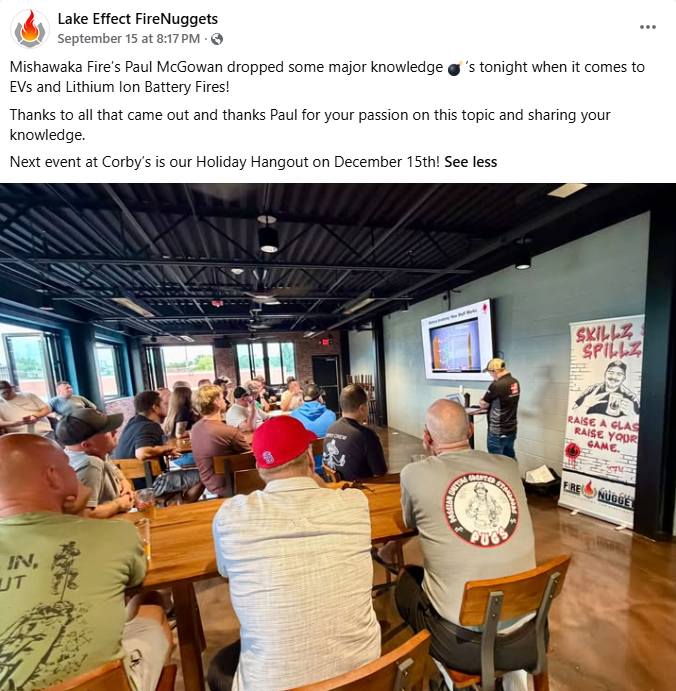
Thanks to everyone who came out to Skills and Spills last month! Please let me know if you're interested in a similar talk for your department! My current email is jpaulmcgowan@gmail.com (working on setting one up dedicated to the site soon!)